European leaders are to make a historic decision on whether to launch the continent’s first human space-flight programme.
Ministers will meet in Rome on 15 December to decide whether to give the green light to a programme that will ultimately cost €10bn (£8.4bn) and aim to cut Europe’s dependence on the US for getting astronauts into space.
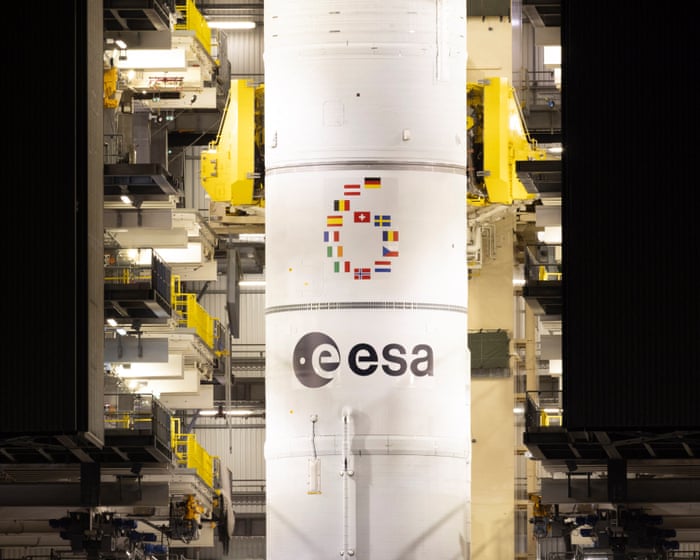
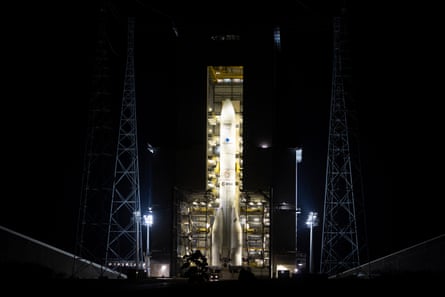
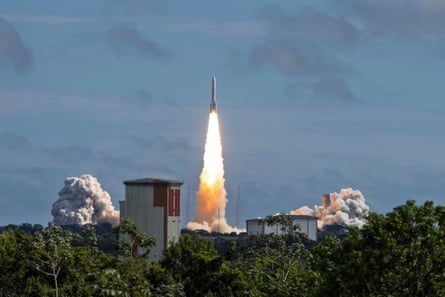
It would require the construction of a European space shuttle, as well as launch and landing pads. These are likely to be in French Guiana, home of the Guiana Space Centre, where the commercial launch provider Arianespace has been sending satellites into orbit for Europe for around 45 years.
“If the decision is positive, that would be quite a historic moment for Europe,” said Josef Aschbacher, the director general of the European Space Agency (Esa).
The commercialisation of space by tycoons such as Elon Musk, alongside growing concerns over Russia’s military space plans – including a potential nuclear weapon – had exposed vulnerabilities in Europe’s space plans, he said.
The recent restrictions on Ukraine’s use of Musk’s Starlink satellite network will add urgency to the discussions in Rome, alongside this week’s reminder of the SpaceX chief’s ambitions after getting regulatory approval to launch 1m satellites to process data in space.
“The desire to have more autonomy certainly has to do also with geopolitical circumstances. There are uncertainties right now [over] how human spaceflight will continue in the United States,” Aschbacher said.
He said relations with Nasa were “good and strong” but things “could change” in the US, and Europe had to be prepared for every eventuality.
He said the plan was not to stop using Nasa, but to supplement it, making Europe a “space power” alongside Russia, China and the US, and establishing sovereignty and industrial opportunities in Europe with industrial spinoffs of hi-tech engineering.
Aschbacher has already been involved in talks with Japan and the United Arab Emirates.
Depending on who was in the White House, he said, the US government could downgrade Nasa or even ban foreign access to private and public US spaceflights.
Europe currently has 11 astronauts in space, with four more scheduled to go to the International Space Station (ISS) next year through Nasa.
Until 2022, Esa relied on Nasa and Russian launchpads to get European astronauts to the ISS.
European countries have not tried to launch their own human space programme since the Hermes project in 1992, a space plane to rival Nasa’s space shuttle. It was abandoned during the development phase amid rising costs in the wake of the Challenger tragedy.
Esa has argued that continuing to rely on Nasa for human space flights is not just risky, but could mean large chunks of European taxpayers’ money will ultimately go into US coffers.
“It funds companies in the US instead of our own companies. And stronger US companies would weaken our own companies because they would be pushed out of the market,” Aschbacher said, also citing the trickle-down effect of space exploration, which has been driven by by extreme engineering.
Aside from the obvious – such as aviation, satellite television and mobile phones – space exploration has given the world inventions such as memory foam, scratch-resistant lenses, medical imaging, heart pumps, camera phones and cordless power tools.
“Why is it important [to have control of our own space programme]? Because we would become, next to China, Russia and the US, a nation that would be capable of bringing its own astronauts to space,” said Aschbacher. “That means this is really a stepping up of European industry in a future domain that is very important, a critical infrastructure.”
It was reported this week that Russia may be planning to launch nuclear weapons into space.
There were also reports in October that a low-earth satellite belonging to Russia, Kosmos 2612, came within a mile of a commercial Earth observation satellite that may be used to provide national security to countries such as Ukraine.
“We do not know exactly what the intention was, or what they had in mind, but the demonstration that they are not only capable of doing it, but they are doing it … is concerning,” said Aschbacher.
He said talks of space wars were also “raising concerns”, and that blowing up a section of space would inflict damage on everyone, including the aggressor.
“Once you kinetically damage other satellites or deploy such weapons, then the whole orbits are being destroyed and made unusable [for everyone],” he said.
Recent restrictions on Ukraine’s access to Starshield, a powerful military version of Starlink developed by Musk’s company for the Pentagon, have fueled questions about the pace and urgency of Europe’s space military capabilities and its ability to compete with Starlink, which has been a vital part of Ukraine’s drone warfare.
Europe’s IRIS² project, a rival to Starlink, will not be operational until 2029, despite being brought forward a year.
Aschbacher agreed that SpaceX was “some years ahead” but said Europe did have OneWeb, a UK-French-backed constellation of 600 satellites in low orbit, and when IRIS² did launch, it would offer a superior level of technology to Starlink.
On defence and security he said Europe was “catching up very fast” .
Esa’s 1975 founding mandate to operate for “exclusively peaceful purposes” arguably held Europe back. But last November the mandate was changed to support “non-aggressive defence and security missions”, and the budget rose to a record €22.1–€22.3bn, a 33% increase on past budgets. Germany contributed 23%, followed by France and Italy at 16% each.
“This is a complete change of mandate,” said Aschbacher, who can now talk “proactively” to defence ministers and the military.
Even with a strong relationship with Nasa, Europe had no say in the recent pause of two projects, the lunar gateway and the Mars sample return project, which would have brought back particles from the planet.
If Esa gets the green light from its 23 member states in December, the agency will start preparatory work using €280m freed up by the Nasa project pauses, with a full funding call being made at the next Esa ministerial budget session in 2028.